
What a van needs before it can be wrapped
A wrap is fitted to a vehicle, not printed onto a picture of one. Most of what decides how the finished job looks happens before any vinyl is unrolled.
Delta Media Services Retail BrandingVisual Concepts
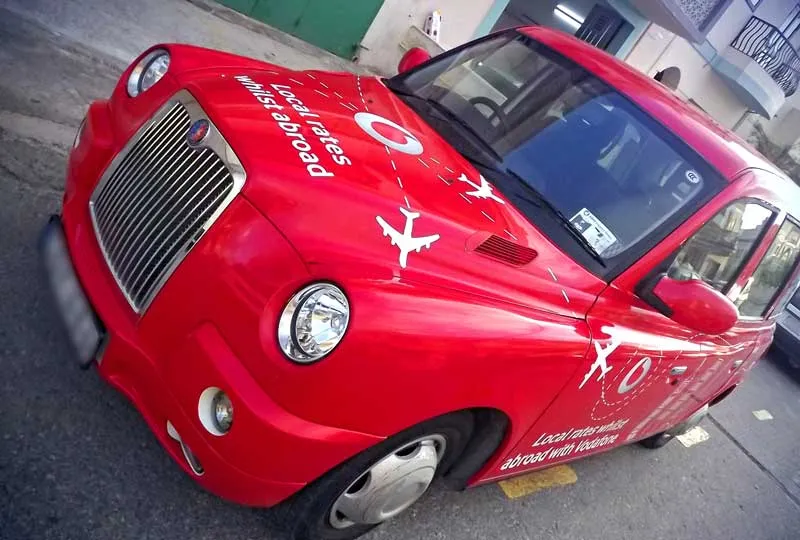
People usually arrive with a design and a van, in that order, and assume the second is a surface the first gets applied to. It is closer to the truth to say the van is the design brief. A panel van, a Transit, a taxi and a helmet are four completely different canvases, and the artwork that reads well across one of them will fall apart on another.
The survey comes first
Every job is surveyed before it is quoted. That is not a formality — it is where the questions that change the price get asked. How many panels. Where the door shuts fall. Whether there are roof bars, ladder racks, side steps or a tow bar that has to come off and go back on. Whether the rear doors are glazed. Whether there is existing livery, and if so what condition it is in and what is underneath it.
A quote given from a photograph is a guess, and guesses get corrected halfway through a fitting, which is the worst moment for anyone.
The surface decides the finish
Vinyl bonds to paint. It does not bond to what is on the paint.
That means the vehicle has to arrive clean, and clean means more than a wash: wax, polish, traffic film and the residue around handles and shuts all have to come off. Where the paint itself has failed — a rust bloom, a flaking respray, a repaired panel that was never properly finished — the wrap will follow the fault rather than hide it, and in some cases lifting the vinyl later takes the bad paint with it. We would rather say so at survey than after.
New vehicles have their own version of this. Fresh paint and factory panel sealants need time to gas off before anything is laid over them.
Panel lines are the layout grid
The single most common artwork problem is a design drawn as a flat rectangle. A van is not a flat rectangle. It has:
- Door shuts, where the vinyl is cut and tucked, and where a word landing across the gap will be interrupted.
- Recesses and swage lines, where the material has to be worked in with heat and where a straight line stops being straight.
- Handles, mirrors, fuel flaps and lights, which are cut around.
- Corrugations on some panel vans, which swallow fine detail completely.
So the logo goes where there is flat, uninterrupted material. Contact details go where they can be read from a pavement by someone who is not moving — usually the rear doors, because the rear is what the traffic behind you spends its time looking at. And the phone number is set larger than looks right on screen, because on screen you are eighteen inches away and in the street they are twenty feet away.
The artwork itself
Vector wherever the artwork will allow it: a logo scaled to a metre across has nowhere to hide. Where photography is unavoidable, it needs to have been shot at a resolution that survives the enlargement, and that is a question to settle before the shoot rather than after.
Where a design has to be seen before it is committed to, we visualise it on the actual vehicle first. Planning is the mother of construction — no great architectural feat has ever been reached without thorough pre-design, and the same is true of something that is going to be stuck to a van for five years.
After it is on
Leave it a few days before washing it. Then hand wash rather than a brush rollover, and keep the pressure washer’s lance back from the edges and the seams, which is where lifting starts if it is going to start anywhere.
Parked in full Maltese sun every day of its life, a wrap ages faster than one that lives under cover. That is worth knowing when you plan the replacement, not when you discover it.